
+86-138 1986 0588
dean_lin@altolative.com

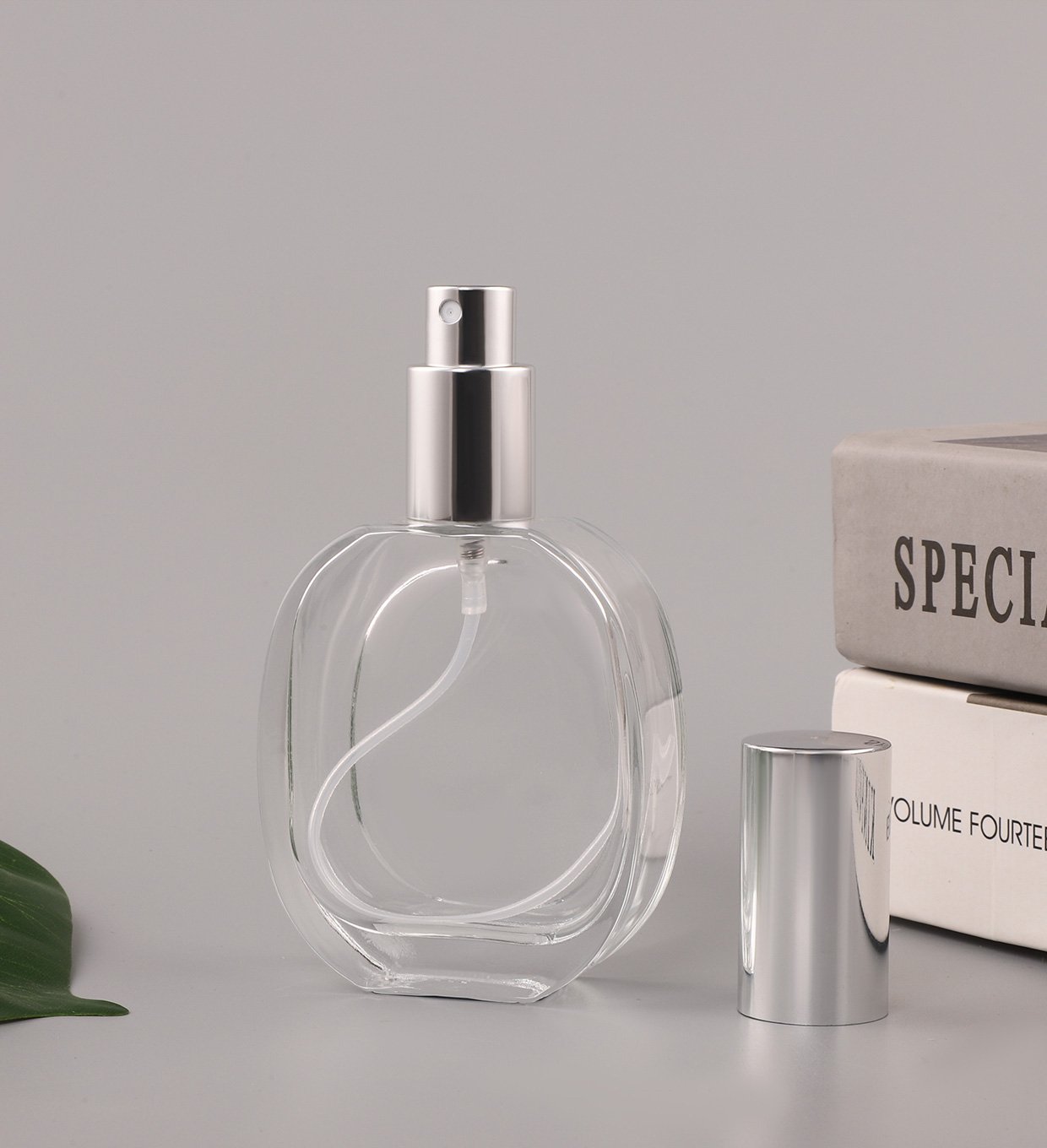
The manufacturing of perfume glass bottles is a complex process that balances precision molding, aesthetic appearance, and protective performance. The core process revolves around four main stages: raw material preparation, molding, annealing, and post-processing. The specific steps are as follows:
Perfume glass bottles require extremely high transparency, corrosion resistance, and gloss. The raw material formula must be strictly proportioned:
Quartz sand (silicon dioxide) is the main component (approximately 70%), combined with soda ash (sodium carbonate) to lower the melting temperature, limestone (calcium carbonate) to improve stability, and feldspar to optimize molding performance.
The raw materials are crushed and ground into fine powder, and iron impurities are removed through magnetic separation (to prevent black spots and discoloration on the bottle). They are then mixed evenly in the correct proportions to create the batch mixture.
1. The batch mixture is fed into a tank furnace or crucible furnace and continuously melted at a high temperature of 1500–1600℃ for 4–6 hours.
2. During the melting process, compressed air is introduced for stirring to remove bubbles from the melt (to prevent “pinholes” in the bottle), while controlling temperature uniformity to ensure a fine and impurity-free glass liquid.
3. The result is a clear and transparent glass liquid, which is then cooled to 1100–1200℃ before entering the molding process.
The molding of perfume glass bottles is divided into two types: mold molding and manual molding. Mold molding is the mainstream method for industrial mass production:
Depending on the bottle structure, it is further divided into two types: press-blow molding and blow-blow molding:
Press-blow molding (suitable for short, thick-walled bottles)
① Feeding: A quantitative amount of glass liquid is dropped into the mold (female mold). ② Pressing: A metal punch (male mold) is used to press down on the molten glass, forming the bottle preform (basic shape), including the bottle mouth, shoulder, and body.
③ Blowing: The preform is transferred to a molding mold, and compressed air is introduced to expand the molten glass inside the mold, conforming to the inner wall of the mold to form the final bottle shape.
④ Demolding: After the glass cools to a certain hardness, the mold is opened and the bottle is removed.
Blowing – Blow molding (suitable for slender, thin-walled bottles)
① First, the molten glass is blown into a hollow bottle preform (a basic shape with a small opening).
② The preform is placed in a molding mold, and air is blown again to expand it to the target size. This is suitable for making high-end perfume bottles with slender necks and thin bodies.
For limited edition and artistic perfume glass bottles, craftsmen use a blowpipe to dip into the molten glass and create the bottle through manual blowing, shaping, and cutting. This allows for complex and irregular shapes, but the production volume is low and the cost is high.
Newly formed perfume glass bottles have internal thermal stress (due to the difference in cooling speed between the surface and the interior), and are prone to cracking if used directly. Annealing is necessary:

After annealing, the perfume glass bottles need to undergo several post-processing steps to meet the quality requirements of perfume packaging:
The perfume glass bottles are inspected manually or by machine for dimensional accuracy, transparency, and surface defects (bubbles, scratches, color differences), and defective products are removed.
Qualified products are cleaned and dried, then placed in shock-resistant packaging for shipment.
1. Raw Material Purity: Strictly control the iron content to ensure the bottle is colorless and transparent.
2. Bubble Control: Thorough stirring and clarification during the melting stage to prevent bubbles in the bottle.
3. Dimensional Accuracy: Mold tolerances are controlled within ±0.1mm to ensure compatibility between the bottle neck and accessories.
4. Surface Finish: Thorough polishing during the post-processing stage, free from scratches and pitting.
Further Information: Special Performance Requirements for Perfume Bottles
Perfume contains alcohol, so glass bottles need to be chemically resistant (not reacting with the perfume) and have good sealing properties (high neck precision to prevent evaporation). Some high-end products also use crystal glass raw materials to improve refractive index and texture.
Comparison Table of Manufacturing Process Differences Between Perfume Glass Bottles and Ordinary Glass Bottles:
| Comparison Dimensions: | Perfume Glass Bottles: | Ordinary glass bottles (beverage bottles/condiment bottles): |
| Raw Material Formulation | Primarily made of high-purity quartz sand, with an iron content <0.03%, combined with feldspar and high-quality soda ash, with strict impurity control; high-end models use crystal glass raw materials to enhance transparency and refractive index. | Ordinary silica sand, iron content ≤0.1%, can be mixed with recycled glass (crushed glass) to reduce costs, lower purity requirements. |
| Melting Process | Tanking furnace melting temperature: 1500–1600℃, held for 4–6 hours, with compressed air stirring and vacuum degassing to ensure the molten glass is free of bubbles and streaks. | Melting temperature 1400–1500℃, holding time 2–3 hours, no vacuum degassing required, a small number of micro-bubbles are allowed. |
| Molding Process | Main production methods are blown-blown (slender, thin-walled bottles) or pressed-blown (short, thick-walled bottles), with mold precision ±0.1mm; high-end custom models are hand-blown, allowing for complex structures such as irregular shapes and reliefs. | Primarily pressed-blow molded, mold precision ±0.3mm, focusing on high production efficiency, mostly standardized cylindrical/square structures, no complex shapes. |
| Annealing Treatment | Annealing furnace temperature: 500–600℃, held at a constant temperature for 1–2 hours, then slowly cooled at 1–2℃/minute to completely eliminate internal stress and improve temperature resistance (preventing bottle cracking due to perfume evaporation). | Annealing temperature 450–500℃, holding time 30 minutes–1 hour, cooling rate 3–5℃/min. Minutes are sufficient to meet basic usage requirements. |
| Cold Working Treatment | High-precision grinding and polishing are essential, resulting in smooth, burr-free bottle mouth edges suitable for perfume pump heads. The bottle cap requires a tight seal; additional processes such as frosting, sanding, and cutting can be added to enhance the texture. | Simple cutting and trimming are all that’s needed; the bottle mouth precision only needs to meet standard sealing requirements, no additional polishing is required; very little sanding or other processing is done. |
| Surface Decoration | It covers a variety of processes including screen printing, hot stamping (gold/silver), laser engraving, chemical etching, and color spraying + high-temperature curing, ensuring high decorative precision and strong adhesion, emphasizing brand aesthetic presentation. | Low-cost screen printing is the primary method, only printing product information, without complex decorative processes; spraying is mostly a low-temperature process, which is prone to peeling. |
| Quality Inspection | Full inspection for dimensional accuracy, transparency, and surface defects (bubbles, scratches, color difference) is conducted using machine vision inspection combined with manual re-inspection, keeping the defect rate below 0.5%. | Sampling inspection is the main method, focusing on capacity, bottle mouth sealing, and no obvious damage. A small number of appearance defects are allowed, with the failure rate controlled within 3%. |
| Performance Requirements | It must possess resistance to alcohol corrosion (to avoid reacting with perfume ingredients), high sealing performance (to prevent evaporation), and high light transmittance (to showcase the perfume color). | Emphasis is placed on water resistance and basic sealing performance; resistance to organic solvent corrosion is not required, and light transmittance requirements are low. |
| Cost and Production Capacity | The process is complex, costing 3–10 times more than ordinary perfume glass bottles; mass production line capacity is approximately 50,000–100,000 bottles/day, while handcrafted versions have a capacity of only a few dozen bottles/day. | The process is simplified and the cost is low; mass production line capacity can reach 500,000–1,000,000 units/day, with significant economies of scale. |
